




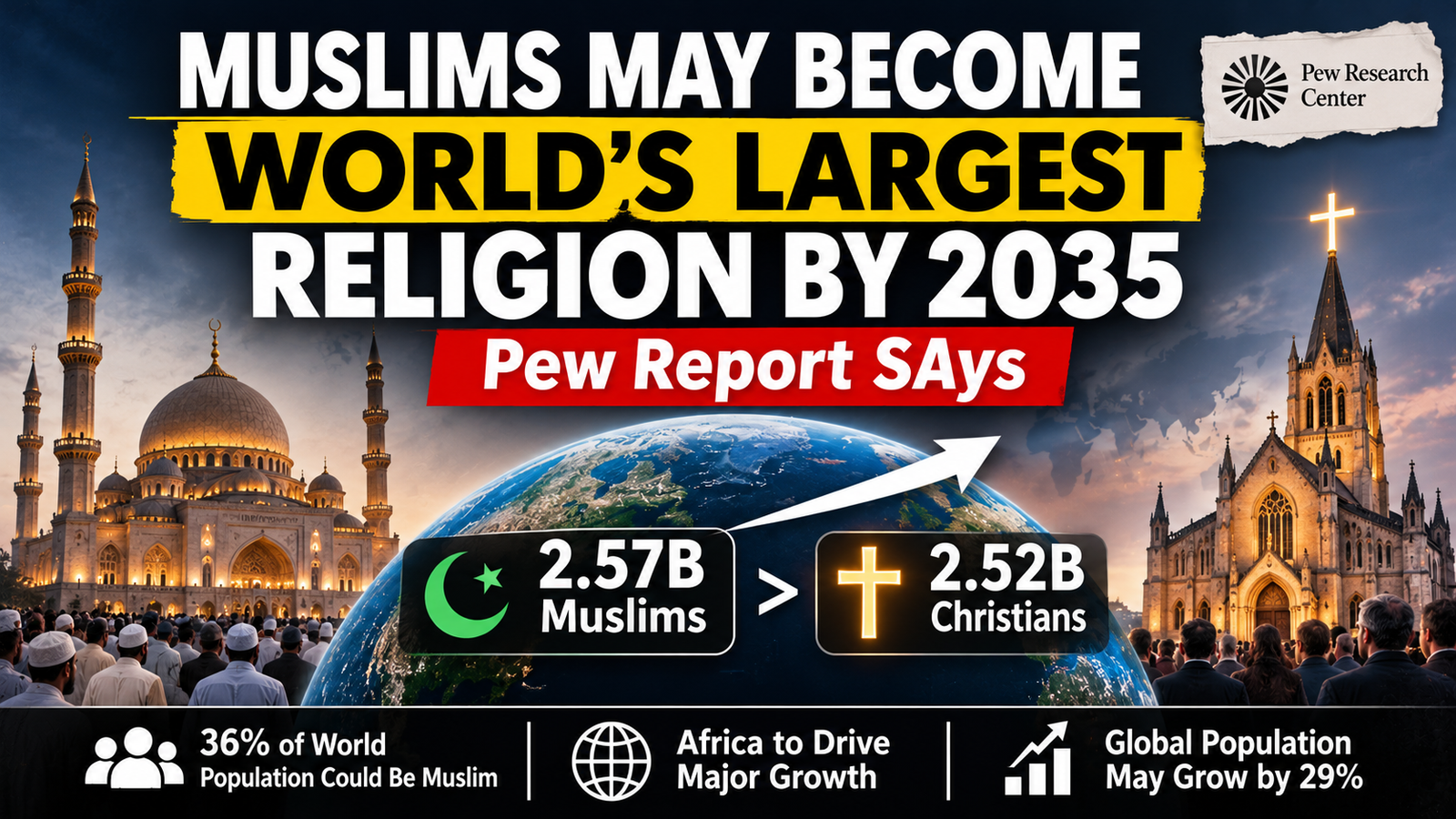
Muslims could become the world’s largest religious group by 2035, overtaking Christians, according to projections by the Pew Research Center.
The report estimates that the world could have around 2.57 billion Muslims and 2.52 billion Christians by 2035. Both groups may grow, but the Muslim population could rise faster.
The study looks at changes in the world’s major religious groups. It examines birth rates, age groups, migration and people who change their religion.
Why Is the Muslim Population Growing Faster?
Higher birth rates play a major role in Muslim population growth, according to Pew.
Between 2020 and 2025, Muslim women had an average of 3.1 children. Christian women had an average of 2.5 children during the same period.
Women from other religious groups had an average of 1.6 children.
Muslims also have a younger population. In 2020, the median age of Muslims stood at 24. The median age of people from other groups stood at 33.
As a result, more Muslims are entering the age when people often start families. This could help the Muslim population grow faster in the coming years.
What Could Happen by 2070?
Pew also offers projections for the next several decades.
The report estimates that the Muslim population could rise above 3.6 billion by 2070. The Christian population could reach just under 3 billion.
Muslims could make up 36% of the world’s population by then, compared with 26% in 2020.
Meanwhile, Christians could account for around 29% of the global population.
Pew expects the world’s total population to grow by 29% between 2020 and 2070. However, the Muslim population could rise by around 80%.
Africa Could Drive Much of the Growth
Africa, especially the region south of the Sahara Desert, could play a major role in future population growth.
Many countries in this region have young populations and higher birth rates. Both Christianity and Islam have large communities there.
Pew expects more than half of the world’s Christians to live in sub-Saharan Africa by 2070.
The Democratic Republic of the Congo could also pass the United States as the country with the largest Christian population. Its Christian population could reach around 299 million.
At the same time, Pakistan could overtake Indonesia as the country with the largest Muslim population.
What About Other Religions?
The report also studies Hinduism, Buddhism, Judaism and people who do not follow any religion.
The Hindu and Jewish populations could grow in number. However, their share of the world’s population may fall.
Buddhism could see a decline in both its total population and its share of the global population.
The share of people who follow no religion could also fall. Pew estimates that this group may account for 17% of the world’s population in 2070, down from 24% in 2020.
Does This Mean Christianity Is Declining?
No. Pew does not expect the total number of Christians to fall.
In fact, the Christian population could grow by around 30% between 2020 and 2070.
However, the Muslim population may grow at a faster rate. This could change the ranking of the world’s two largest religious groups.
Pew also says that birth rates and age patterns play a much bigger role in these changes than people switching religions.
What Do These Findings Tell Us?
The projections show how birth rates, age groups and population changes can shape the future of religion around the world.
However, these figures do not guarantee what will happen. Changes in birth rates, migration and religious identity could affect the results.
The report offers a look at how the world’s religious population may change over the next few decades.
Must Read:https://theglobalcurrent.com/brooklyn-building-collapse-death-toll/