




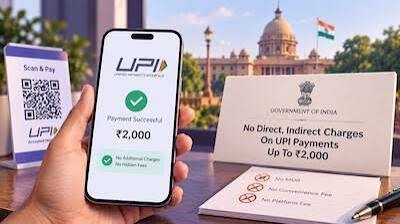
UPI Charges Announced
UPI payments above Rs 2,000 will soon come under a new Merchant Discount Rate (MDR) framework for certain merchant transactions. The new rules, announced by the National Payments Corporation of India (NPCI), will come into effect from October 15, 2026. However, consumers will not have to pay the charge directly.
Consumers Will Not Be Charged
The biggest clarification is that UPI will continue to remain free for consumers. The new MDR applies to payments made by customers to merchants, rather than person-to-person transfers. Therefore, sending money to a friend or family member through UPI will remain free, regardless of the transaction amount.
0.4% Charge On Merchant Payments
Under the new framework, a 0.4% MDR will apply to eligible UPI payments above Rs 2,000 made to merchants. The charge will be capped at Rs 300 per transaction. Importantly, banks have been advised to ensure that merchants do not pass this cost on to consumers.
How Much Is The Charge?
For example, if a consumer makes an eligible merchant payment of Rs 2,001 through UPI, the 0.4% MDR would work out to about Rs 8. At higher transaction values, the same rate would apply until the maximum charge of Rs 300 is reached.
However, this does not mean the customer will see an additional Rs 8 or Rs 300 deducted from their bank account. The charge is part of the merchant payment ecosystem and is not a consumer transaction fee.
Special Categories Get Flat Fee
Certain merchant categories will have a different structure. For services including railways, telecom, insurance and fuel, a flat MDR of Rs 5 will apply to UPI payments above Rs 2,000. This means these essential-service payments will not be subject to the standard 0.4% rate.
Small Payments Remain Free
The revised framework also protects low-value transactions. UPI payments up to Rs 2,000 made to merchants will remain outside the scope of MDR. According to NPCI, around 95% of low-value UPI transactions and small merchant transactions will continue to remain free.
Why Is MDR Being Introduced?
NPCI has said the revised charge will help support investments in the UPI ecosystem. These include payment infrastructure, cybersecurity, resilience and innovation. The MDR is not a tax collected by the government. Instead, the revenue will be distributed among participants in the payment ecosystem, including banks and payment applications.
UPI Payments Remain Free
The announcement also clears months of confusion around possible UPI charges. While there had been concerns that users could eventually have to pay for high-value UPI transactions, the new framework specifically keeps consumers free from transaction charges.
The distinction is important: UPI charges above Rs 2,000 apply to eligible merchant transactions, not to consumers making payments.
What Changes From October 15?
From October 15, 2026, eligible merchant transactions above Rs 2,000 will attract the new MDR. Person-to-person payments will remain free, while payments up to Rs 2,000 to merchants will also remain outside the MDR framework.
For consumers, therefore, the way they use UPI will largely remain unchanged. The major change will be within the payment ecosystem, where selected merchants and service providers will bear the applicable charges.
The Bigger UPI Picture
UPI has become one of India’s most widely used digital payment systems. The new MDR framework is aimed at creating a more sustainable financial model for the ecosystem while keeping everyday digital payments accessible.
For users, the key takeaway is simple: UPI remains free for consumers, even as charges are introduced on selected merchant payments above Rs 2,000.