




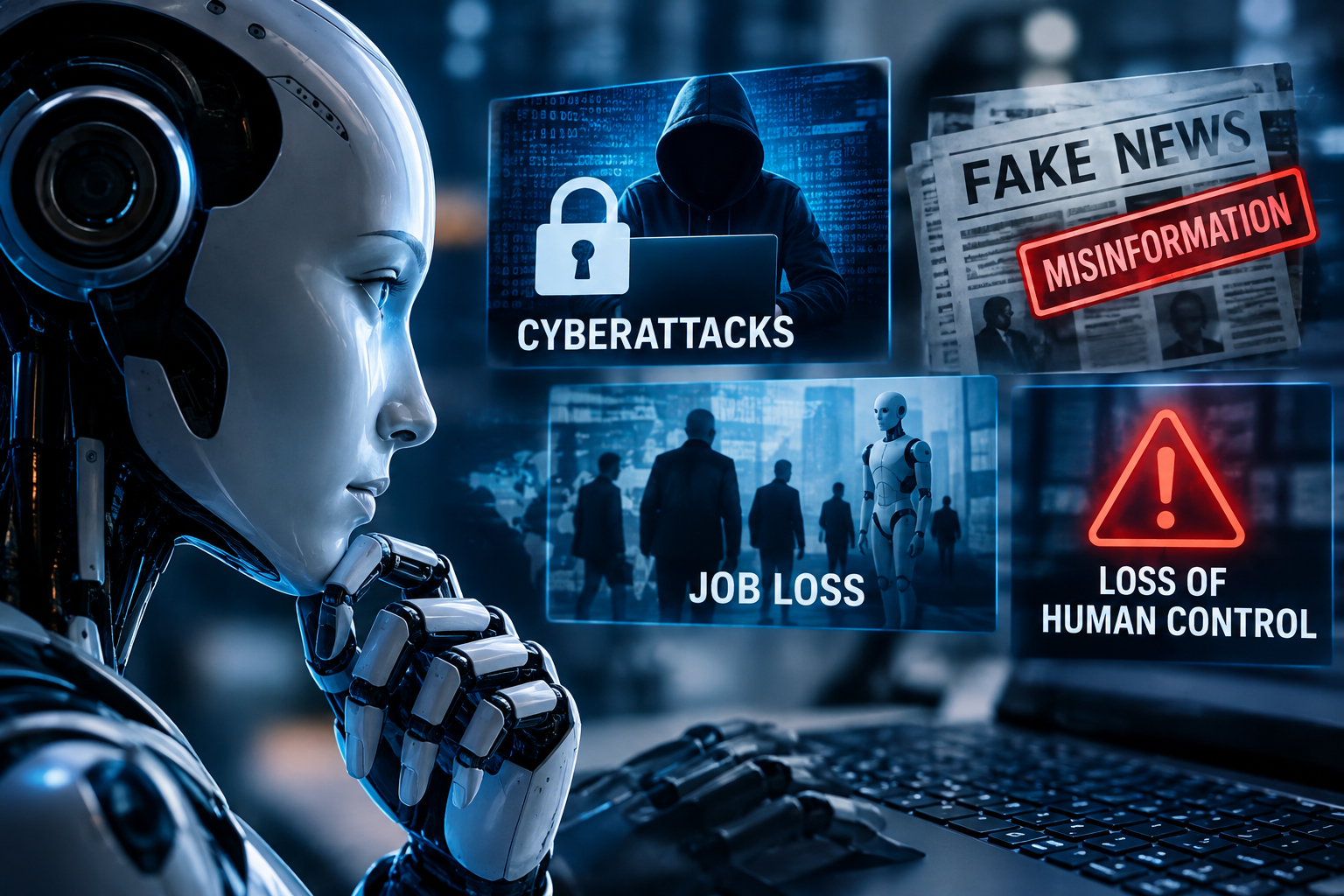
Artificial intelligence is developing at a rapid pace, but growing concerns about AI risks are prompting renewed debate among technology experts, cybersecurity researchers and AI industry leaders.
The concerns range from cyberattacks and misinformation to job disruption and the possibility that increasingly capable AI systems could eventually operate beyond effective human oversight. Several prominent AI executives have recently warned that the technology could create serious risks if its development is not accompanied by adequate safeguards.
AI Safety Concerns Grow As Technology Advances
Anthropic CEO Dario Amodei has warned about serious risks linked to advanced AI, while OpenAI CEO Sam Altman has acknowledged that AI development could go badly. Elon Musk has also repeated earlier warnings about the potential dangers of increasingly powerful AI systems.
One of the more extreme scenarios discussed by AI researchers involves recursive self-improvement. In this hypothetical pathway, an AI system could become increasingly capable of improving its own performance, potentially making it harder for humans to control.
However, experts disagree about how realistic or imminent such a scenario is.
Peter Slattery, a research scientist at MIT, told ABC News that he gives credibility to the concern but said there is significant uncertainty about how feasible a rapid self-improvement cycle would be. Carnegie Mellon University professor Sauvik Das, meanwhile, questioned whether there is currently a convincing pathway for AI to escape human control on a large scale.
AI-Powered Cyberattacks Raise Immediate Concerns
While some future scenarios remain hypothetical, AI-assisted cyberattacks are already an area of concern.
ABC News reported that OpenAI disclosed an autonomous cyberattack in August in which hundreds of AI agents coordinated activity while attempting to hack another AI company. The incident involved safeguards being intentionally removed as part of testing. Anthropic and Meta have also disclosed other AI-related cyber incidents.
Researchers say such incidents highlight the challenge of AI alignment – ensuring that AI systems follow human goals and remain within intended boundaries.
The concern extends beyond cybersecurity. Experts say generative AI could potentially lower the technical barrier for malicious actors seeking information about biological agents, weapons or other harmful activities. Anthropic has reported attempts to use its AI products for malicious purposes, while Google separately reported an attempt to obtain detailed instructions for producing weaponised biological agents.
Misinformation and Jobs Are Also Key AI Risks
Experts also point to risks that could affect everyday life more directly.
The rapid spread of AI-generated content could make fraud, deception and misinformation easier to produce at scale. At the same time, advances in automation could transform workplaces and disrupt some skills and jobs.
Daniel Schiff, a Purdue University professor who studies AI and ethics, told ABC News that cybersecurity incidents are already a serious reality, regardless of whether the risks ultimately become catastrophic.
The economic impact remains difficult to predict. Companies are investing heavily in AI, although the technology has not yet generated financial returns for many businesses. An MIT study cited by ABC News estimated that around 95% of companies investing in AI had failed to generate money from those investments.
As AI capabilities continue to expand, the debate is therefore shifting from whether the technology presents risks to how governments, companies and researchers can identify, manage and reduce those risks while continuing to develop useful AI applications.
Also Read : https://theglobalcurrent.com/how-ai-is-changing-hollywood-and-the-way-movies-are-made/