




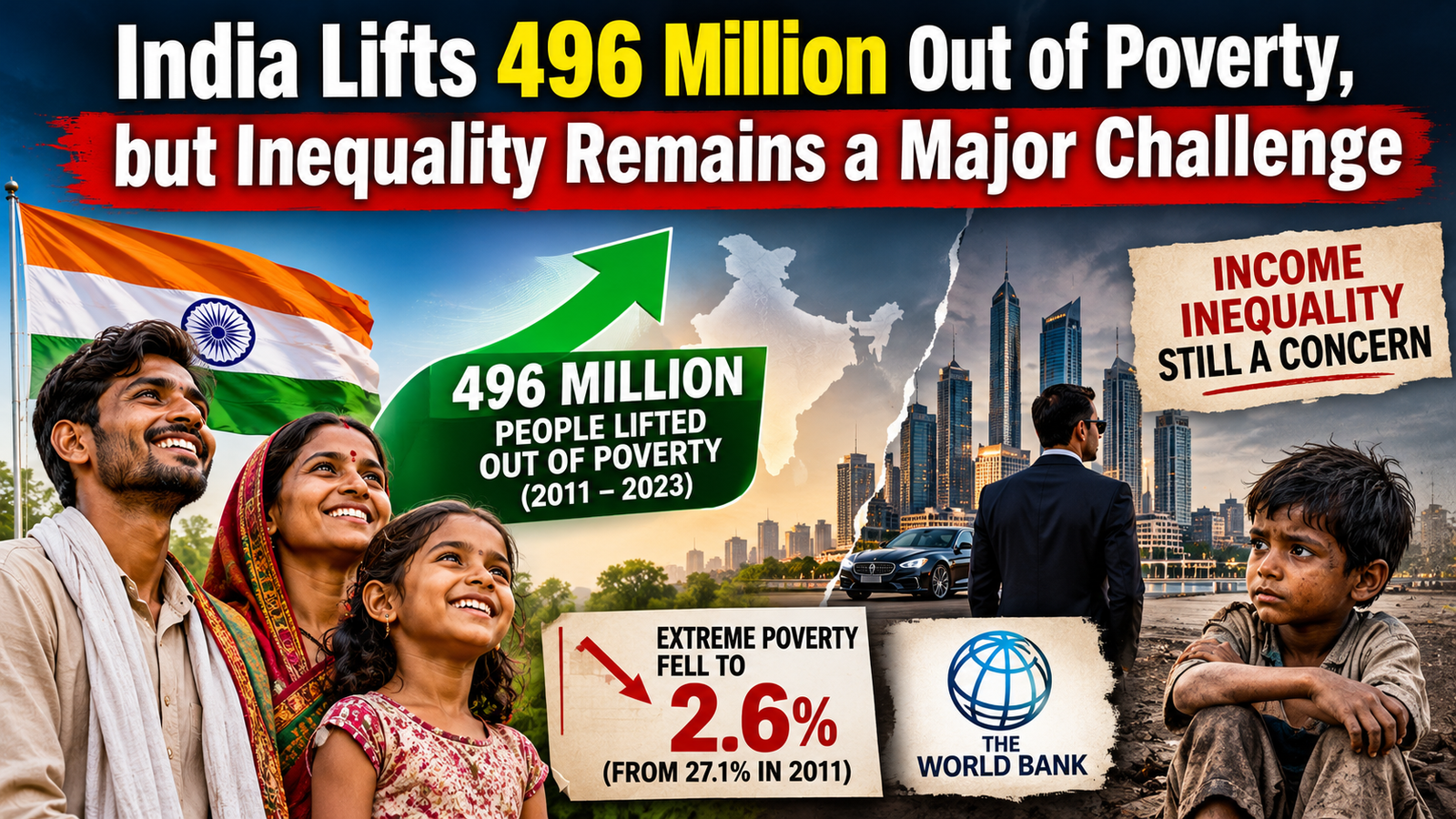
India has lifted nearly 496 million people out of poverty between 2011 and 2023, according to the World Bank. However, rising income inequality continues to raise concerns about the country’s economic future.
India has made major progress in reducing poverty over the past decade. According to the World Bank’s latest report, nearly 496 million people moved above the lower-middle-income poverty line between 2011 and 2023.
The report also highlights a sharp fall in extreme poverty. Its rate dropped from 27.1% in 2011 to just 2.6% in 2023.
However, the figures reveal another side of India’s economic growth. While millions have moved out of poverty, the gap between wealthy and poorer households remains a serious concern.
What Does the World Bank Report Reveal?
The World Bank measured poverty using two international income levels.
At the $3-a-day extreme poverty line, India’s poverty rate fell from 27.1% to 2.6%.
Meanwhile, the share of people living below the $4.20-a-day lower-middle-income poverty line declined from 57.7% to 16.1%.
These figures show the scale of India’s progress over 12 years. However, millions of people still struggle to meet their basic needs.
How Did India Reduce Poverty?
Economists point to several factors behind this improvement.
Economic growth, rising employment and government welfare programmes have helped improve household incomes and living conditions.
Successive governments introduced schemes to support rural employment, provide food assistance and improve housing facilities.
The government also expanded access to toilets and clean drinking water in rural areas.
For example, access to piped drinking water increased from 17% of rural households in August 2019 to more than 80%, according to government figures.
Furthermore, free food grain programmes now support around 800 million Indians.
Why Does Income Inequality Remain a Concern?
Despite falling poverty, India continues to face a large income gap.
According to the 2026 World Inequality Report, the richest 10% receive around 58% of India’s national income. In comparison, the bottom 50% receive only 15%.
The World Bank also reported a major wage difference. In 2023, median earnings among the top 10% of workers stood around 13 times higher than those of the bottom 10%.
Economists say unequal access to education, healthcare and employment opportunities contributes to this problem.
What Challenges Lie Ahead for India?
India still faces several economic challenges, including youth unemployment, uneven wages and limited access to quality public services.
Some economists have also questioned the country’s dependence on international poverty estimates. They argue that India needs its own updated poverty measurements to reflect changing living standards.
Moreover, experts believe that better public healthcare, quality education and fair taxation can help reduce inequality.
The World Bank expects poverty levels to decline further in the coming years. However, the pace of improvement may become slower.
India’s progress shows that large-scale poverty reduction is possible. Yet the next challenge is to ensure that economic growth creates opportunities for people across all income groups.
Must Read : https://theglobalcurrent.com/us-teen-hindu-temple-shooting-plot-illinois/