




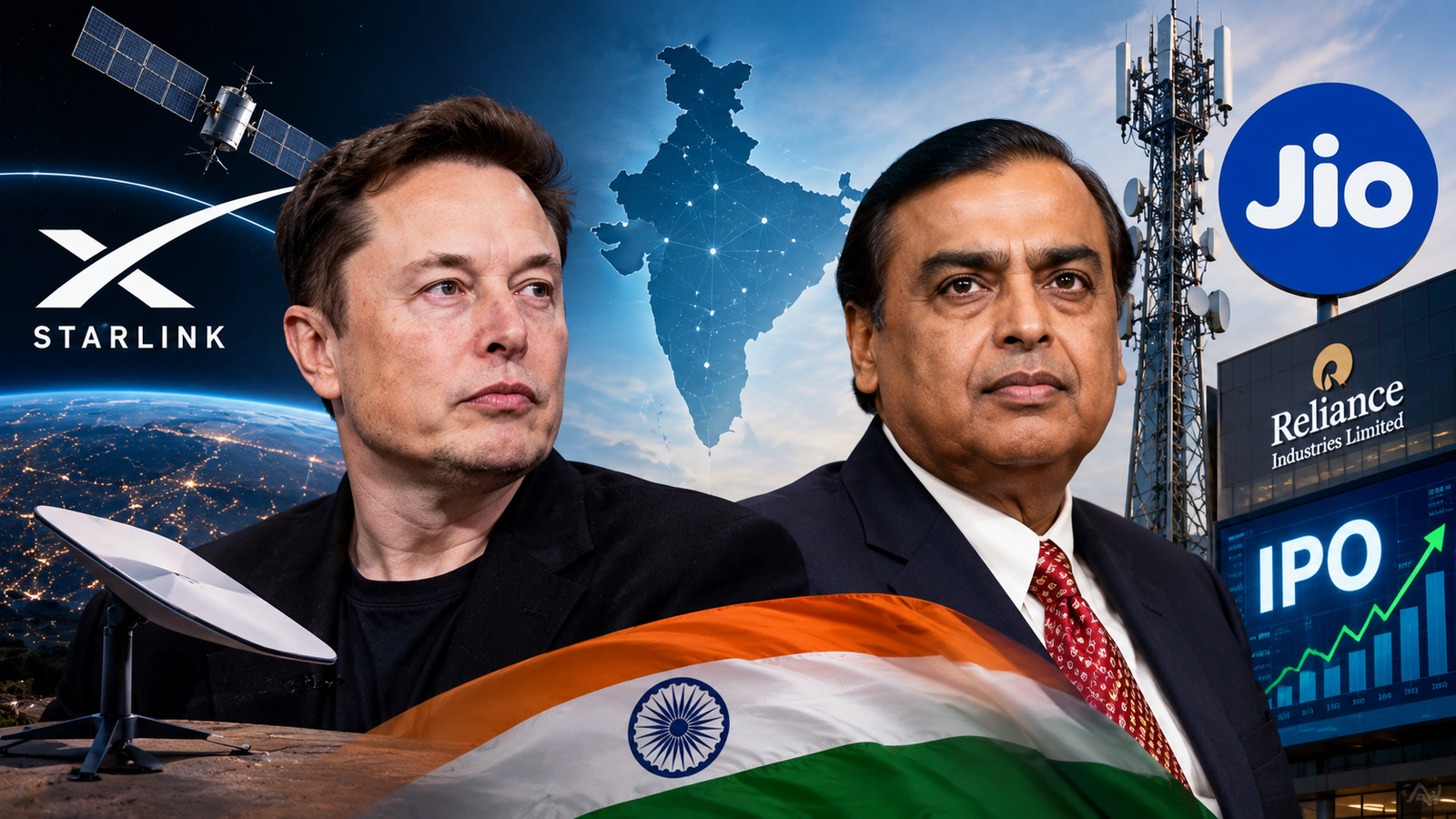
Elon Musk’s Starlink is waiting to launch satellite internet services in India, while Mukesh Ambani’s Jio prepares for a major stock market listing. The clash highlights a global battle for internet users, market share and digital power.
A high-stakes business rivalry is unfolding in India, bringing together two of the world’s most influential billionaires: Elon Musk and Mukesh Ambani.
Musk wants to expand Starlink, his satellite internet service, into India’s vast market. Ambani’s Reliance Jio already serves more than 530 million customers and has built its business around affordable internet access.
The timing adds another layer to the contest. Jio Platforms is preparing for a record initial public offering (IPO), while Starlink continues to await the clearances needed to begin commercial operations in India.
The dispute goes beyond two business leaders. It raises questions about competition, regulation and who will control the next phase of global internet growth.
Why Is Elon Musk Challenging Mukesh Ambani?
Musk has publicly criticised delays in Starlink’s India launch. He has suggested that powerful business interests are trying to protect established telecom companies from competition.
He has also directly questioned Ambani’s influence over India’s market.
India has denied favouring domestic companies. Its communications ministry has said satellite operators must complete security assessments before they can receive the approvals needed to launch services.
Starlink, Jio’s satellite internet venture and Bharti-backed Eutelsat OneWeb have all secured certain licences. However, they still face outstanding requirements before commercial operations can begin.
Reliance has responded by saying it welcomes competition. The company has also said its own satellite services are waiting for the required clearances.
This means the dispute is not simply about one company gaining entry. It also concerns how India applies its rules to global technology firms and domestic competitors.
Jio’s Record IPO Raises the Stakes
The dispute comes as Jio Platforms prepares for a major stock market listing.
The company is seeking a valuation of about $108 billion, making the planned offering one of India’s biggest market events.
Jio Platforms brings together Reliance’s telecom business and a wider range of digital services. These include broadband, digital applications, enterprise services and cloud infrastructure.
Its huge customer base gives it a strong position in India’s digital economy. The business has also attracted major technology investors, including Meta and Google.
However, investors will look beyond the company’s subscriber numbers. They will want to know whether Jio can turn its large user base into sustained revenue growth.
Future opportunities include artificial intelligence, data centres, enterprise technology and satellite connectivity.
The IPO could therefore shape how global investors value India’s telecom and digital services sectors.
Why India Matters to the Global Satellite Internet Race
India offers a major opportunity for satellite internet providers.
Although mobile connectivity is widespread, many remote and rural communities still face gaps in reliable broadband access. Satellite services could help connect homes, businesses and public institutions in areas that traditional networks struggle to reach.
Starlink uses a network of low-Earth-orbit satellites to deliver internet access through specialised equipment on the ground.
Unlike conventional broadband, the service does not depend on a direct fibre connection to every customer. This can make it useful in remote locations.
For Musk, India represents a major potential market. The country’s large population could support significant demand if the service meets local needs and prices.
Yet entering India will require more than technology. Starlink must meet regulatory requirements, build distribution networks and compete on affordability.
Jio has an important advantage: an established customer base and experience offering low-cost internet services.
Musk’s Global Strategy Meets Ambani’s Local Advantage
The rivalry reflects a wider change in the telecommunications industry.
Satellite companies are increasingly competing with traditional telecom operators. Their aim is to extend connectivity beyond the reach of existing mobile and broadband networks.
Similar contests could emerge in other countries where satellite providers seek access to large markets.
Musk has said he wants Starlink to offer affordable services in India. However, the company has not announced a final Indian pricing plan.
Jio, meanwhile, has already shown how low prices can transform a telecom market. Its entry helped drive down data costs and expand internet use across India.
The challenge for Starlink will be to offer a service that customers consider worth the price. Rural households, businesses and organisations in remote locations could become important customer groups.
For Jio, the challenge is different. It must protect its position while expanding into new areas of digital technology.
What the Rivalry Means for Global Investors
The Starlink-Jio contest has implications beyond India’s telecom sector.
Investors are watching how satellite connectivity could change the value of established telecom businesses. They are also assessing whether internet providers can turn new technology into profitable services.
Jio’s IPO will test investor confidence in India’s digital economy. Its valuation will depend on growth prospects, earnings and its ability to expand beyond traditional telecom services.
Starlink’s India launch could create another source of competition. However, the company must first complete the required approvals before it can begin commercial operations.
Regulation will remain a key factor. Governments must balance investment and competition with security concerns and national interests.
A Bigger Battle Over the Future of Connectivity
The contest between Musk and Ambani is part of a wider struggle to connect the world’s remaining offline communities.
Satellite internet could help bring businesses, schools and households online. At the same time, it could challenge the market power of established telecom companies.
India now sits at the centre of this debate because of its huge digital market and its growing role in the global technology economy.
Jio has scale, local reach and an established customer base. Starlink brings a satellite network with international ambitions.
The outcome will depend on regulatory approvals, pricing, service quality and the ability to win customers.
For global technology companies and investors, the stakes are clear: India’s next phase of internet growth could help shape the future of the worldwide connectivity market.
Also Read : https://theglobalcurrent.com/subhash-chandra-breaks-silence-on-nclt-case-debt-claims-and-his-future-plans/