




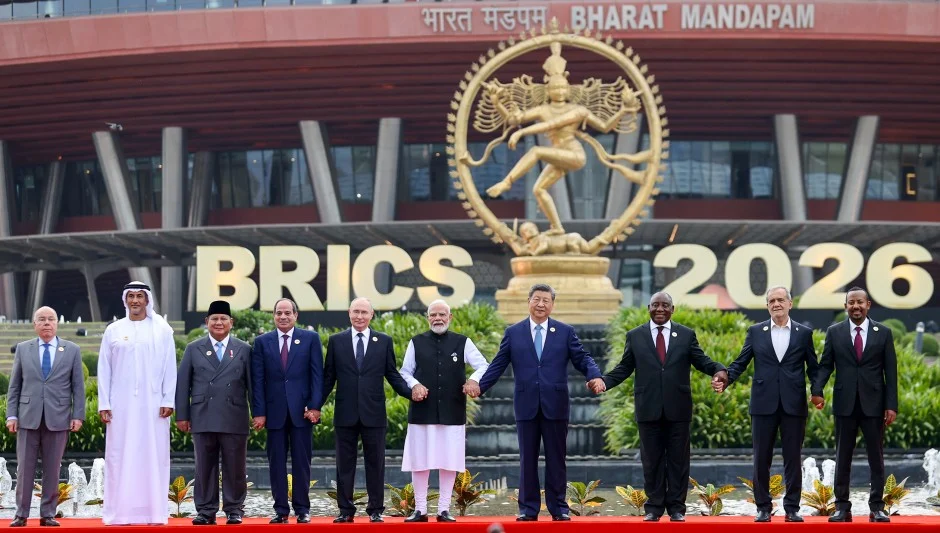
India’s BRICS Success
India’s BRICS 2026 presidency has given New Delhi more than a successful summit. It has created greater diplomatic space at a time when global politics is increasingly divided. The 11-member grouping adopted a 140-paragraph declaration despite differences over conflicts, trade, sanctions and regional tensions as per NDTV
The India BRICS 2026 presidency also highlights New Delhi’s growing role in shaping global economic cooperation and strategic partnerships.
India BRICS 2026: Managing Differences
India’s biggest diplomatic achievement was keeping BRICS united despite its internal disagreements. With countries such as Iran and the UAE in the same room amid tensions in the Middle East, reaching consensus was not straightforward. New Delhi managed to prevent these differences from derailing the summit.
Push For UN Reform
The summit also strengthened India’s argument for reform of the United Nations Security Council. BRICS members backed a greater role for developing countries, while Russia and China reiterated support for India’s permanent membership aspirations. This allows India to position itself as a voice for the wider Global South.
Economic Opportunities
The BRICS Economic Partnership Strategy 2030 is another important outcome. It aims to strengthen trade and investment among member countries while encouraging more resilient supply chains and greater participation of developing economies in high-value manufacturing. However, implementation will determine whether these commitments produce actual economic gains.
Payments And The Dollar
Payments could become one of the most closely watched areas after the summit. BRICS members discussed cross-border payments and greater use of local currencies for trade. However, this should not be interpreted as the immediate creation of a BRICS currency or the end of the dollar’s dominance.
India’s UPI Advantage
For India, digital payments offer a practical area of influence. Discussions around linking payment systems such as India’s UPI with Brazil’s Pix show how New Delhi can offer infrastructure and technology rather than simply advocate for alternatives to Western financial systems.
Critical Minerals
Critical minerals are another area where BRICS could become strategically important for India. Lithium, cobalt, nickel and rare earths are increasingly important for electric vehicles, electronics and renewable energy. Diversifying access to these resources can reduce supply-chain risks, particularly given China’s strong position in several parts of the global minerals ecosystem.
Technology Cooperation
BRICS is also looking at cooperation in science and technology, including areas such as quantum computing and research. Nevertheless, India cannot depend on BRICS alone for advanced technology, capital or semiconductor expertise. Western countries, Japan and other partners remain crucial to India’s technology ambitions.
Why The West Still Matters
The real challenge for India is therefore not choosing BRICS over the West. Instead, New Delhi must maintain strong relationships with both. The United States remains important for defence and technology, Europe for trade and clean energy, Japan and Australia for supply-chain diversification, while Russia remains significant for energy and defence ties.
China’s Growing Role
China will assume the BRICS chairmanship in 2027, making Beijing a key factor in India’s strategy. India will need to cooperate with China where interests overlap while ensuring that BRICS does not become dominated by Chinese economic priorities.
Strategic Autonomy
India’s approach is increasingly moving beyond traditional non-alignment. New Delhi is building relationships across different power centres while developing alternatives that reduce dependence on any single country. The objective is greater strategic autonomy, not isolation.
The Real Test Begins Now
The success of BRICS 2026 will ultimately be judged by what happens after the summit. Declarations must translate into investment, factories, technology partnerships, reliable supply chains and stronger trade. India has gained diplomatic space; its next challenge is converting that space into economic and strategic capability.
India is not choosing BRICS over the West. It is trying to build enough strength and options so that it never has to choose between them.
You can also read Tim Cook Apple Products: 5 Biggest Hits That Redefined Apple

1 Comment
Pingback: BRICS Foreign Ministers Meet in New Delhi as India Calls for Stronger Global Cooperation - The Global Current