




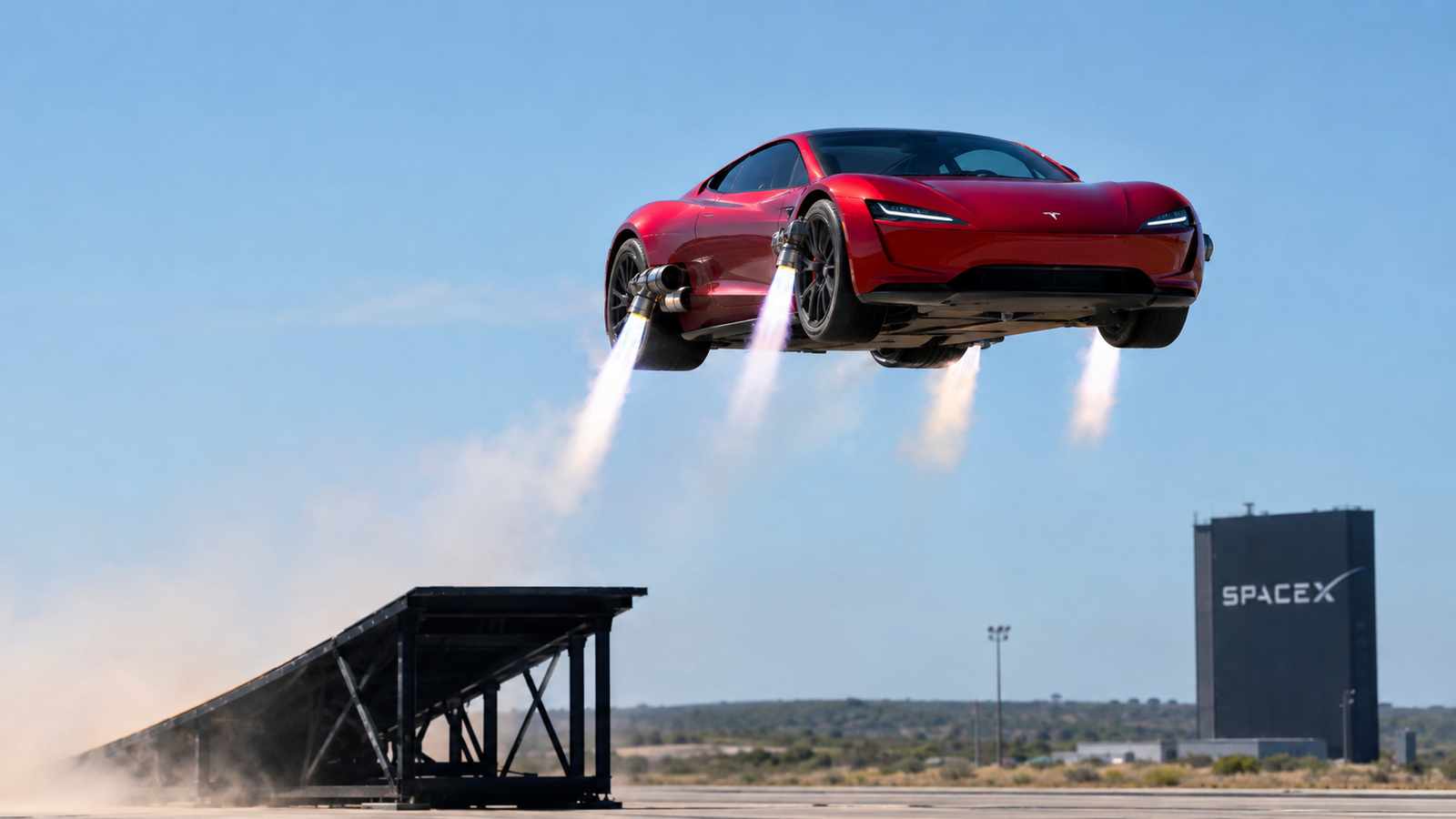
Tesla’s new Roadster briefly flew during a demonstration in Texas using SpaceX technology. But how high can it go, how much will it cost, and can it become a practical flying car?
Tesla has brought the idea of flying cars closer to reality with a dramatic demonstration of its next-generation Roadster. The electric sports car briefly left the ground, performed an aerial manoeuvre and landed safely.
The demonstration took place at a SpaceX facility in McGregor, Texas, on October 15, 2026. The car also drove upside down on a specially designed curved ramp and jumped over other vehicles.
Elon Musk shared a video of the demonstration on X, writing that the future does have flying cars.
However, the demonstration has raised several questions. Tesla has not confirmed how high the Roadster can fly, how far it can travel in the air or how long it can stay airborne.
How High and How Far Can the Tesla Roadster Fly?
Tesla has not shared exact figures for the Roadster’s flight height, distance or duration.
The demonstration showed the car briefly leaving the ground under controlled conditions. However, it did not prove that the vehicle can fly over long distances or remain in the air for an extended period.
A short jump and sustained flight are two very different things. The Roadster’s ability to perform an aerial stunt does not automatically make it a flying car for everyday use.
For now, buyers will have to wait for Tesla to share more details about the vehicle’s flight capabilities.
How Does the Tesla Roadster Fly?
The Roadster uses special thrusters developed with SpaceX technology. These devices release pressurised gas to produce thrust, which can help lift and move the vehicle.
Unlike conventional rocket engines, cold-gas thrusters do not burn fuel to generate thrust. Instead, they release stored gas at high speed.
Tesla’s vehicle engineering head, Lars Moravy, explained that the system uses 10 thrusters connected to a 600-litre compressed-air supply, according to a report by TechCrunch.
This technology could allow the Roadster to perform short aerial movements that conventional cars cannot manage.
However, the system faces several challenges.
Weight: The compressed-air tanks and thrusters add weight to the vehicle.
Safety: A sudden burst of thrust or a technical fault could put passengers and people nearby at risk.
Flight time: The car’s time in the air will depend on the amount of compressed gas available and how the system uses it.
Practical use: A car that can jump briefly may look impressive, but that does not mean it can replace an aircraft or solve everyday traffic problems.
Tesla will need to demonstrate the system’s safety and reliability before its wider use becomes clear.
Tesla Roadster Price: How Much Will It Cost?
Tesla has opened reservations for the next-generation Roadster, but buyers should understand the difference between a booking amount and the final vehicle price.
The Performance version requires a reported reservation payment of $50,000, while the Thrust version requires $250,000.
The company has also described a more specialised Rocket version, which customers can access by invitation.
These amounts relate to reservations, not necessarily the final prices buyers will pay. Tesla has not confirmed the complete final pricing details for all versions.
The Roadster first appeared in 2017, and its launch has faced repeated delays. Tesla now plans to begin production in 2028.
However, the company has yet to deliver the production model. Buyers should therefore treat the planned timeline as a target rather than a guarantee.
Will Owners Need a Special Licence to Fly the Tesla Roadster?
The legal requirements for using the Roadster’s thrusters remain unclear.
A regular driving licence may cover road use if the vehicle meets the required standards. Using its flight system could involve additional rules, depending on how regulators classify the technology.
Owners may also face questions about insurance and safety training.
For example, standard motor insurance may not cover damage caused by an airborne manoeuvre. Insurers would need to assess the risks before deciding what protection to offer.
The same questions would apply in India if Tesla eventually introduces the vehicle here.
Indian authorities would need to consider the relevant road safety, vehicle approval and aviation rules before allowing any airborne operation.
Tesla has not announced a final set of licensing or insurance requirements for the Roadster’s thrusters.
Can the Tesla Roadster Become a Practical Flying Car?
The demonstration has renewed interest in flying-car technology. However, turning an impressive stunt into a useful form of transport will take much more work.
First, Tesla must show how far the car can travel in the air and how long it can remain airborne.
Next, the company must prove that the system works safely beyond a controlled demonstration.
Regulators will also need to decide where owners can use the technology and what safety rules they must follow.
Finally, Tesla must show that the system offers a real benefit to drivers. A brief jump over an obstacle may attract attention, but it does not solve the wider problems of traffic congestion or daily travel.
For these reasons, the Roadster’s flying features remain experimental rather than a proven solution for everyday transport.
Tesla Roadster Launch Date: What Happens Next?
Tesla plans to begin Roadster production in 2028, although the company has not guaranteed that deliveries will start on schedule.
The latest demonstration has offered a glimpse of its ambitions for the electric sports car. Yet important details about flight performance, safety, final prices and legal approval remain unanswered.
The next major test will be whether Tesla can turn the demonstration into a reliable production vehicle.
For now, the Roadster has delivered an eye-catching showcase of automotive technology. Whether it becomes a safe and practical flying car remains an open question.
Also Read : https://theglobalcurrent.com/elon-musk-openai-cursor-deal-ending/