




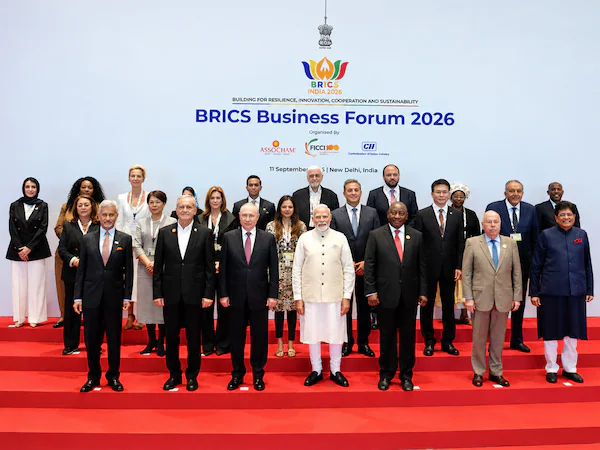
The 2026 BRICS Summit in New Delhi brought together leaders of the expanded 11-member group at a time of major global tensions. The two-day meeting was held on September 12 and 13, with trade, wars, global governance and the role of the Global South high on the agenda.
The leaders adopted the New Delhi Declaration on the first day. The statement covered issues ranging from the Middle East and Ukraine to trade, climate change and reforms of global institutions.
BRICS Calls for a Bigger Global South Role
One of the main themes of the summit was the demand for greater representation for developing countries. BRICS said global institutions should better reflect the current balance of the world economy.
Prime Minister Narendra Modi called on the Global South to become a “rule-shaper” rather than simply follow rules made by others. The declaration also backed reforms of institutions such as the United Nations, IMF, World Bank and WTO.
The bloc also repeated its support for a more multipolar world. At the same time, India stressed that BRICS should not be seen simply as an anti-Western grouping.
Trade Tensions and US Tariffs
Trade was another major issue at the BRICS Summit 2026. The New Delhi Declaration raised concerns over unilateral tariffs and other trade restrictions. However, it did not name the United States directly.
The group called for stronger cooperation to protect global trade and supply chains. It also opposed sanctions imposed without approval from the UN Security Council. The issue was important for several BRICS members facing trade pressure from the US.
The bloc also backed reforms to make the global trading system more representative and effective.
Palestine Gets Strong Support
BRICS used stronger language on the issue of Palestine. The declaration opposed the forced displacement of Palestinians and attempts to change the demographic or geographic character of the occupied Palestinian territory.
The group also called for humanitarian access to Gaza and continued support for UNRWA. It backed full UN membership for Palestine and repeated its support for a two-state solution based on the 1967 borders, with East Jerusalem as the capital of a Palestinian state.
Iran War Exposes Differences
The conflict involving Iran was one of the most difficult issues for BRICS. The group called for restraint and expressed concern over rising tensions in the Middle East.
However, the declaration did not directly name the US, Israel, Iran or Gulf countries when discussing the conflict. This was different from the stronger language used by BRICS in its previous declaration on the issue.
The careful wording reflected the different interests of BRICS members. Iran is part of the group, while the UAE is also a member and has faced Iranian attacks during the conflict.
Ukraine War and Multipolar World
The Ukraine war also remained a sensitive issue. The BRICS declaration did not directly name Ukraine. Instead, it called for disputes to be resolved through dialogue, consultation and diplomacy.
The group also repeated its opposition to unilateral sanctions that are not authorised by the UN Security Council. Russia, a founding BRICS member, has faced extensive Western sanctions since its full-scale invasion of Ukraine in 2022.
The New Delhi summit therefore showed both the reach and limits of the expanded BRICS. The group was able to agree on a broad declaration despite major differences between its members. Its next challenge will be turning those shared positions into practical cooperation on trade, development and global governance.
Also Read : https://theglobalcurrent.com/brics-summit-in-delhi-india-set-to-host-key-global-leaders-for-18th-meeting/